

Chemical probe platform
Proprietary Vitcyl probes with high specificity, cell permeability and labeling efficiency for in-cell and in-vitro systems.
A complete service for Vitcylation research, covering probe labeling, affinity enrichment, mass spectrometry and bioinformatics analysis.
A specialist team coordinates the study, aligns the plan with sample characteristics and research goals, and tracks quality at key stages.
A complete research path from probe labeling and enrichment to identification, site localization and functional interpretation.
A one-stop technical service for Vitcylation research, from probe labeling and affinity enrichment to LC-MS/MS identification and bioinformatics interpretation.
From probe labeling and affinity enrichment to MS identification and bioinformatics interpretation, we provide end-to-end technical support.
Vitcylated proteins are selectively labeled with chemical probes, followed by affinity enrichment, LC-MS/MS identification and bioinformatics analysis for confident protein and site detection. Standardized experimental controls and layered quality assessment help ensure stable, reproducible results with clear value for scientific interpretation.
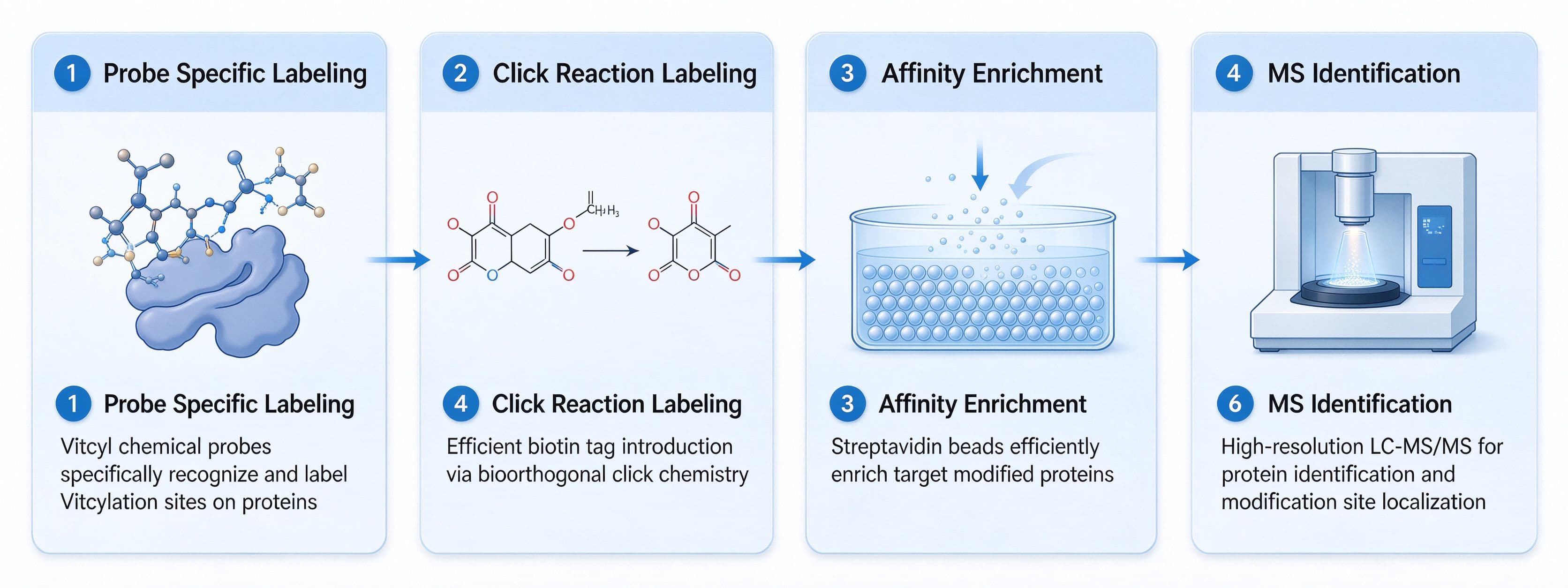
Proprietary Vitcyl probes with high specificity, cell permeability and labeling efficiency for in-cell and in-vitro systems.

A dedicated analysis workflow covers MS preprocessing, protein identification, site localization, differential analysis, annotation and pathway enrichment.
根据研究对象和实验条件,选择合适的标记方案。

Applicable for probe labeling in living cells to study vitamin C modification proteins under physiological conditions.
Apply the probe to live-cell or cultured-cell systems. Evaluate cell viability and labeling signals across conditions before selecting the final treatment. Collect and lyse cells, then perform click chemistry, affinity enrichment and LC-MS/MS analysis to identify candidate intracellular Vitcylation proteins and sites.
Consult In-cell Plan
Applicable for in-vitro labeling of purified proteins or cell lysates, facilitating method optimization and mechanistic studies under controlled conditions.
Use purified proteins, complexes or lysates in a controlled reaction. Record substrate, probe, buffer, cofactors, temperature and reaction time. Include no-probe or key-reagent-omission controls, then quench, click-label, enrich and analyze by mass spectrometry. This plan tests reaction feasibility and candidate substrates; it does not by itself establish native intracellular modification.
Consult In-vitro PlanInclude probe-treated and matched negative-control groups for each research question. Add competition or key-reagent-omission controls when specificity must be assessed. Biological replicates should come from independent cultures, preparations or individuals; technical repeats of one sample are not substitutes. Exploratory studies may begin with at least three independent biological replicates per group, then refine sample size based on effect size, variance and statistical power. Balance batches, randomize where possible, and standardize input, extraction and MS acquisition.
从需求沟通到报告交付,衔接样品、实验与数据
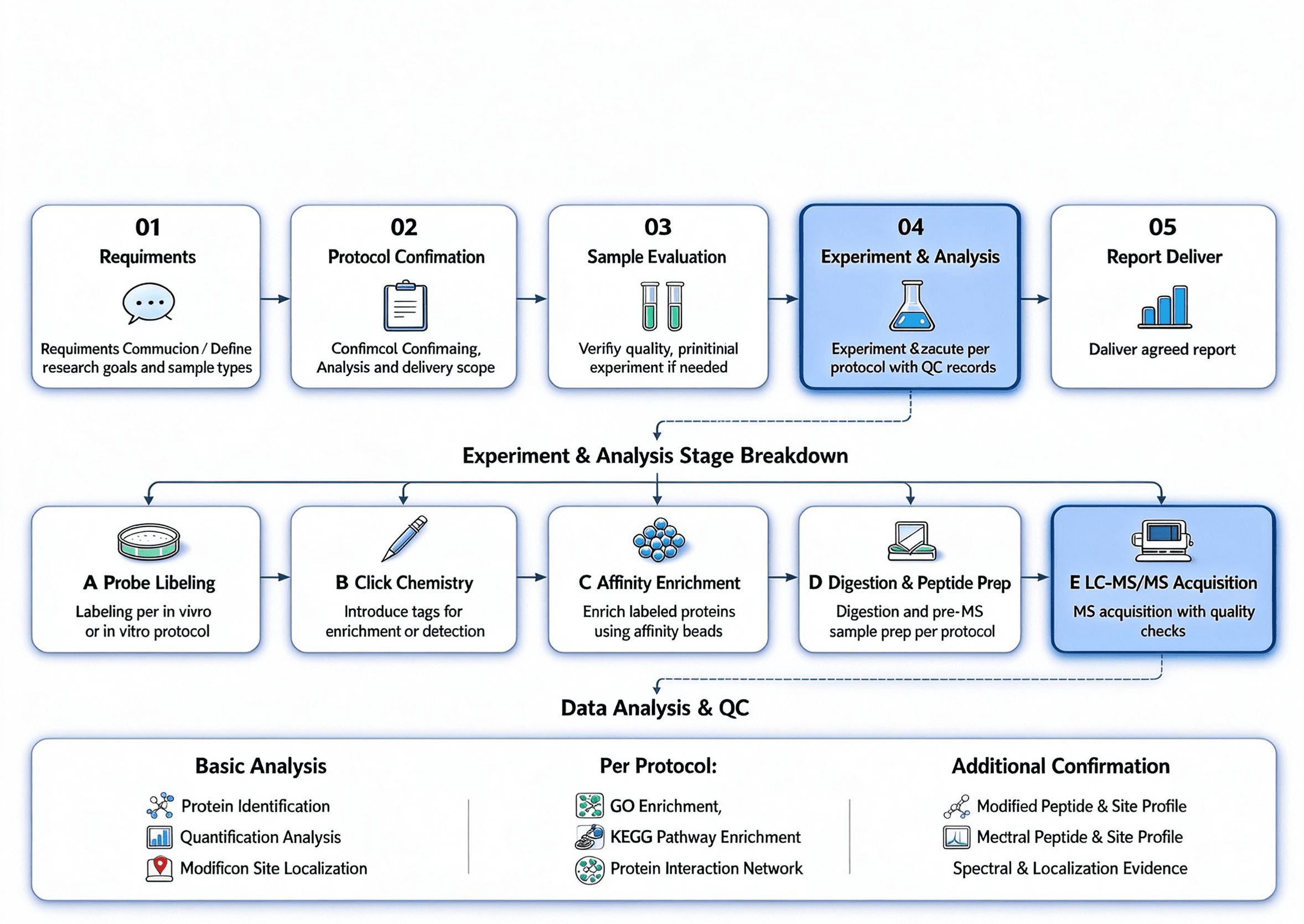
A standardized workflow connects sample quality control, probe labeling, target enrichment, MS acquisition and result QC. The team tracks key experimental conditions and quality checkpoints through delivery.
Progressive bioinformatics analysis from protein identification to modification-site localization.
High-confidence identification with protein names, gene symbols and molecular weights.
Label-free or TMT quantification to identify differentially enriched proteins.
Reveal the biological functions represented by differential proteins.
Identify key metabolic and signaling pathways.
Identify potential core regulatory nodes.
Localize Vitcylation sites at amino-acid resolution.
The recommended amount depends on sample type and study design; we confirm the final amount after technical review.
Specific chemical probes, appropriate negative controls and mass-spectrometry quality control improve confidence in protein and site identification.
A standard project usually takes approximately 3–5 weeks, depending on sample type, number of samples and analysis depth.
Yes. Differential quantification, site analysis and functional pathway interpretation can be provided according to the grouping and replicate design.
Tell us about your research objective, sample type and expected analysis.